She has trust issues, a tech-support parrot, and no room for feelings. Unfortunately, her emergency contact is a very patient wolf shifter. Read My Emergency Contact Is A Wolf Shifter on KindleUnlimited.
The neighbor, Mr. Harlan, was mid lecture, flashlight wagging like punctuation. Exclamation points, mostly. He had settled into his favorite theme. People had no shame anymore. Standards were gone. This used to be a quiet place. Etcetera.
“Evening, Mr. Harlan,” I said. “They’re leaving. No need to keep this going.”
He spun on me, ready to escalate, then took me in. Height like mine does a lot of work before you had to say anything else. He muttered, backed up, and kept backing up.
He grumbled under his breath as he walked away, sweeping the beam toward the trees like he was documenting evidence. The light bobbed away with him, his commentary trailing off until the forest swallowed it.
I stayed put until he was gone, then I turned toward the group of women.
I didn’t look at them, instead fixing my attention to the sky. “You ladies aren’t in trouble or anything, but you probably should head back to your rooms. I’m not trying to ruin your evening, just offering my input as someone with a clear head. I can walk you back if you need.”
There was a beat of silence, then a chorus of agreement that sounded relieved and loud all at once. The mood loosened as they climbed out and wrapped themselves in towels and clothes retrieved from a heap. Morning would not be kind to them.
“Let me know when you’re decent,” I said, still studying the stars.
When they told me it was clear, I turned, keeping my eyes level with shoulders and trees and anything that was not their bodies. I held out a small stack of cards that I fished from my pocket.
“Liam,” I said. “I’m the resident grounds worker here at Pine Hollow Retreat. For transparency’s sake, I’m also a shifter. If there’s an emergency, use the number. I can get to you quickly.”
One of them smiled wide. “Does this count as you giving us your number?”
“For emergencies only,” I said, keeping my voice friendly and firm. “Broken bones. Lost people. Fires. Not karaoke requests.”
They laughed, and one of them snapped a sloppy salute. Another one attempted a curtsy and nearly took herself out doing it.
“Very professional,” one of them said.
“I felt respected,” another replied.
We turned back up the trail together, their voices tangling with each other. The tension bled off fast, replaced by the kind of fearless chatter that only showed up when people thought the danger had passed.
Someone tripped and laughed like it was on purpose.
“Do the deer here judge people?” a voice asked from behind me.
“Yes,” I said.
“Makes sense.”
Most of them kept talking. Two didn’t.
One was tall and striking, walking half a step behind the rest. Her blue hair was not subtle. The color caught every bit of light along the trail, making it impossible to miss and harder to ignore than it should have been. The other woman kept pace beside her, steady and watchful. The taller one kept glancing back, then forward again, like she was counting heads without meaning to. I could relate to that.
I could tell her foot was about to give out a split second before it did.
She let out a sharp, startled yelp, then pitched sideways.
I was there before the sound finished. The ground had given way under her foot, and I spotted the gopher hole. I had been trying to keep an eye out for them for exactly this reason, but I had missed one in the dark.
I took her by the elbow and helped her up.
“I’m fine,” she said immediately.
She was not fine. She tried to step, but she hadn’t regained her balance yet and pitched forward again.
Catching her, I picked her up without thinking. A streak of blue swung across my arm as her hair slipped forward. She was strong and solid but still felt small in my arms.
“I’ve got you,” I said. “We’re going to the nursing station.”
“I do not need to be carried,” she said.
“You do,” I said. “At least until you stop lying about being fine.”
She huffed. “You’re going to hurt yourself.”
“You’re slippery,” I said, adjusting my grip. I was, unhelpfully, a little too pleased that she was in my arms.
“Is that a comment on my weight,” she asked, “or your lack of experience with wet women?”
A laugh broke out behind us.
“Strictly a traction issue,” I said. “I’ll survive.”
She shifted, testing. “I’m heavy.”
“You are not heavy,” I said. “But please stop wiggling.”
“I do not wiggle.”
“You just did.”
She paused, let out a small huff, then settled.
Carrying her was different from everything else I’d handled tonight. The property, the guests, the routines... all of that usually settled the pull to watch and guard and stay alert. It gave that part of me somewhere to live.
This pulled it forward instead. Sharpened it in a way I wasn’t used to.
She shifted in my arms again, and my focus locked down hard, not on the path or the lights or the night, but on getting her somewhere solid and safe and still.
I adjusted my grip and kept moving, aware that something had just changed—and I didn’t dislike it.
When we reached the main building, most of the group peeled off toward the stairs with loud assurances that everything was fine. One woman hesitated.
One woman hesitated. “I’ll come with you.”
The woman in my arms shook her head. “Go. I’ll be fine.”
She said it confidently, like she expected the other woman to obey—which she did.
I steered us toward the golf cart. The night was quieter now, as if the property had finally exhaled.
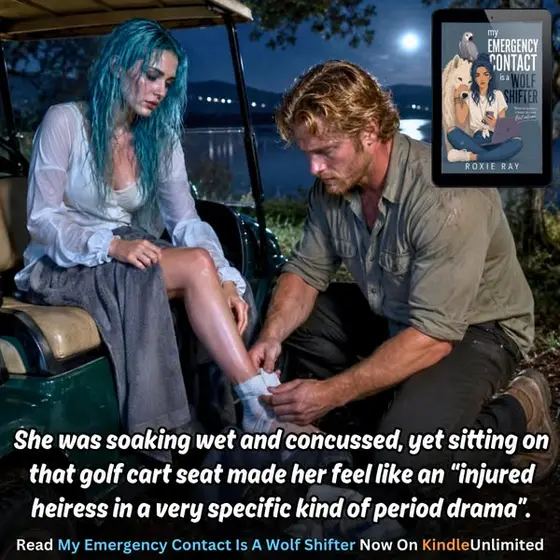
I gently set her on the seat and handed her a towel. “Nursing station’s a short ride. We’ll take a look and decide next steps from there.”
She glanced at the card still tucked between her fingers, then lifted her gaze to mine, chin set despite the towel and the injury and the fact that I was literally loading her into a golf cart like an injured heiress in a very specific kind of period drama.
“For emergencies only,” she said.
I smiled. “You’re learning.”
I turned the key and eased the cart forward, the path lighting up ahead of us.