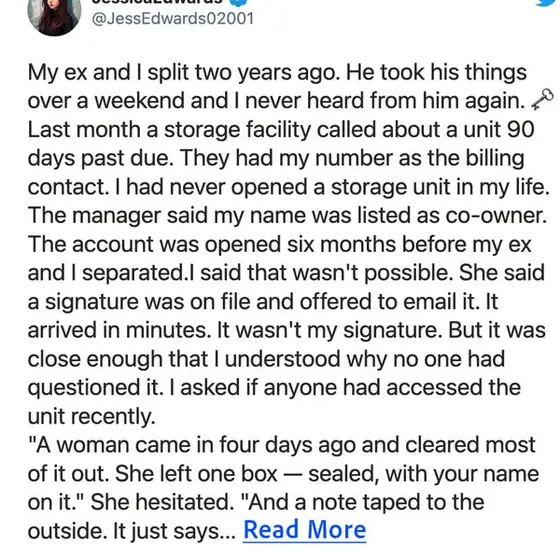
Everyone told me love was supposed to feel good. No one warned me that sometimes love is learning to make excuses for the person who hurts you.
I grew up in a house that was too quiet. Not because it was peaceful — but because all of us had learned to stay silent. Silent when the doors slammed. Silent when, the next morning, my mother smoothed her concealer a little thicker over her cheekbone. I swore to myself when I was still a girl: this will never happen to me. I'll be smarter. I'll choose someone different. I'll break the cycle.
And then I met him.
He came into my life like a breath of air after a long dive underwater. Beautiful enough to stop my heart. Smart, successful, attentive to the little things I forgot about myself. He looked at me like I was the only thing in the world worth having. And for the first time in a long while, I let myself believe I deserved to be happy.
The first months felt like a dream I never wanted to wake from. He knew how to make me laugh. He knew what to say when I was falling apart. He knew me — sometimes, it seemed, better than I knew myself.
And then came the thing I didn't let myself see right away.
A wrist gripped a little too hard. An apology the next morning — so sincere, so desperate, that I was the one who ended up comforting him. "I didn't mean to. You know I'm not like that. I just love you so much, it makes me crazy to think of losing you." And I believed it. God, how I wanted to believe it.
Because I knew his story. I knew the hell he'd been through as a child, the scars he carried inside. And every time something happened, I told myself: it's not him, it's his past. I can heal him. Love heals — that's what I'd always been told.
But between "he slipped" and "it's happening again" lies a chasm you only see later, looking back.
I grew quieter. More careful choosing my words. I started reading his mood the moment I crossed the threshold — the way I once read my father's. I stopped seeing my friends, because it was easier that way. I began to disappear — slowly, piece by piece, and I hardly noticed it happening. The woman who'd sworn this would never happen to her looked back at me from the mirror with her mother's eyes.
And then I found out I was pregnant.
And everything changed. Because now it wasn't only my life anymore. I held the test in my hands and understood: one day this child would grow up in a house that was too quiet. One day they would learn to stay silent when the doors slammed. And they'd ask me the one question I'd have no answer for: "Mom, why did you stay?"
I loved him. That's the worst part — that I really did love him, even then. No one warns you that leaving the person who hurts you is a hundred times harder when, in between the pain, you still see the person you fell for.
But my love for him and my love for myself finally stood on opposite sides. And for the first time in my life, I had to choose.
I thought about that chain — my mother, me, my child. About how pain is handed down like an inheritance, unless someone finds the courage to cut it off.
And I understood who I had to become.
Not the one who endures. Not the one who forgives for the hundredth time. But the one with whom all of it ends.
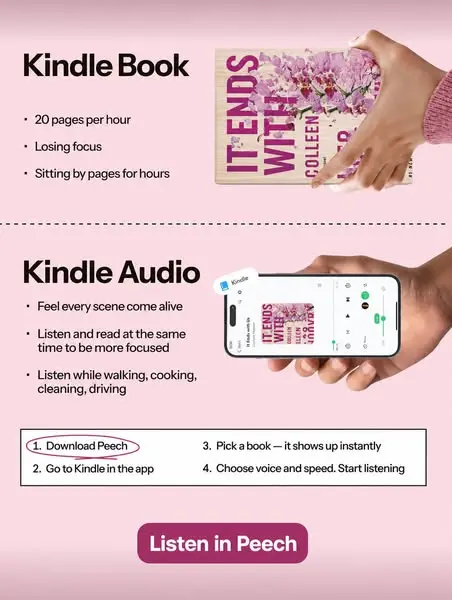
The story has only just begun. Find out if she finds the courage to break the cycle — listen to "It Ends with Us" on Peech.