PixelSpyer

Carnium Botanicals Deutschland ad: Letzte Stunden: Code JULI15 für den letzten Rabatt! ⏰

Letzte Stunden: Code JULI15 für den letzten Rabatt! ⏰
Carnium Botanicals Deutschland

Vitamins/supplements, 4.3K followers, 14 ads in library

InactiveHealth & SupplementsImageLibrary ID 1734304944376042
Launched Jun 26, 2026Run time unknown

New ads are still being tested; watch whether it survives past 30 days.

Ad copy

Letzte Stunden: Code JULI15 für den letzten Rabatt! ⏰

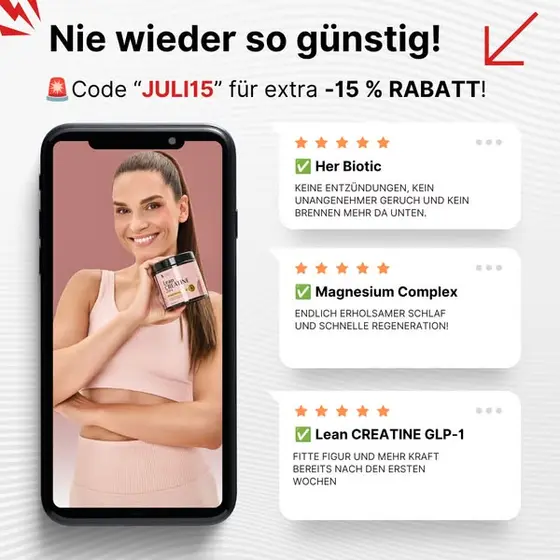
SCHNELL, das ist deine allerletzte Chance! Die Aktion „ALTE PREISE“ läuft jeden Moment ab! ⏰ Aufgrund gestiegener Materialkosten sind wir leider gezwungen, die Preise unserer Produkte dauerhaft zu erhöhen, um weiterhin höchste Qualität zu gewährleisten. Aber vor der offiziellen Preiserhöhung bieten wir dir noch einmal die Gelegenheit, deine Lieblingsprodukte zum alten Preis zu sichern. Dazu gibt es zusätzlich ganze -15 % RABATT mit dem Code JULI15! 🎉 Ab dem 1.7.2026 werden die Preise unwiderruflich höher sein. Nutze diese letzten Stunden und fülle deinen Vorrat deiner Lieblingsprodukte auf: ✔ Her Biotic (für weibliche Balance & Blase) ✔ Magnesium Complex (für ruhigen Schlaf & Regeneration) ✔ Lean CREATINE GLP-1 (für eine fitte Figur & mehr Power) ✔ MenoWELL / Bloat Aid / SKIN Lux … und weitere Verkaufshits! Nie wieder so günstig. Warte nicht, fülle deinen Warenkorb und sichere dir deine Lieblingsprodukte zum alten Preis, solange es noch geht! 🛒💥 👉 Schnell dein Paket bestellen und den Code JULI15 eingeben: https://carniumbotanicals.de/collections/all

carniumbotanicals.deLearn more
Placements
FacebookInstagramMessengerThreads
Reach (0 locations)
Not disclosed
Languages
German

Why this ad works

Hook, angle, audience and three ideas to borrow — written by AI from the ad copy.

Similar ads from other brands

InactiveJul 25, 26
Lange Ärmel. Mitten im Sommer. 😔

rubelena.com

Lange Ärmel. Mitten im Sommer. 😔

Learn more

Sie haben Ihre Ärmel schon wieder nach unten gezogen, bevor irgendjemand etwas sehen konnte. Jeden Tag dasselbe: der schnelle Blick in den Spiegel, das Tuch um den Hals, obwohl es viel zu warm dafür ist. Niemand hat Ihnen je gesagt, dass lose Haut nach dem Abnehmen kein Kollagenproblem ist — es ist ein Elastinproblem. DermaFirm™ Kapseln liefern genau das, was Ihrer Haut fehlt: 🧬 marines Elastinpeptid, das erschlaffte Fasern von innen strafft 💧 marines Kollagenpeptid für neue Spannkraft 🍊 Vitamin C, das jede neu gewonnene Faser schützt Schon nach 36 Stunden spüren die ersten Frauen den Unterschied ✅ — keine OP, keine Cremes, kein Warten auf ein Wunder. 90 Tage Geld-zurück-Garantie, falls es bei Ihnen nicht so ist.

InactiveJun 28, 26
If you're tired of being dismissed and ignored, read this... ☝️

nourial.com

If you're tired of being dismissed and ignored, read this... ☝️

See details

For 3 years I was told my pain was anxiety, and handed another prescription. Then a neurologist pressed something to my chest, and the pain I lived with every day went silent. I sat in her office, holding back tears. Not from the pain this time. Though it was always there, humming in the background, every hour of every day. No. I was crying because I was tired. Tired of being told my pain wasn't real. Tired of hearing "your tests came back normal" like it was supposed to comfort me. Tired of watching doctors glance at their watches while I tried to explain that something was deeply, fundamentally wrong inside my body. "Have you considered that this might be stress-related?" my GP asked, already reaching for her prescription pad. I wanted to scream. If it was stress, why did the pain wake me up at 4 AM, radiating so deep it felt like my bones were humming with electricity? If it was anxiety, why did my shoulders feel like they were filled with broken glass every time I tried to lift my arms above my head? I had tried everything they suggested. Meditation apps. Yoga. Magnesium supplements. CBD oil. Acupuncture. Anti-inflammatory diets. Physical therapy twice a week for eight months. Nothing worked. Or rather... everything worked for a few hours. Maybe a day. Then the pain came crawling back, settling into my body like it owned the place. After my sixth doctor gave me the same dismissive shrug, I did something I should have done years earlier. I found a neurologist who specialized in chronic pain and nervous system disorders. Her name was Dr. Chen. She spent 40 minutes with me. Forty minutes. I almost cried just from being listened to. She ran tests the other doctors never thought to run. She asked questions no one had asked before. And then she showed me something on a nerve conduction study that changed everything. "See this?" she said, pointing to a pattern on the screen. "Your nervous system isn't functioning normally. It's stuck in fight-or-flight mode. Chronic sympathetic activation. Your nerves have become hypersensitive. They're amplifying pain signals that should be minor, and they're firing even when there's no injury present." She set down the chart and looked at me. "Your pain isn't psychological. It's neurological. There's a difference. And the reason nothing has worked is because pills and stretches don't reset a dysregulated nervous system." I sat there in silence, processing. For three years, I had been told I was anxious. Stressed. Overthinking. That I needed to relax. And the whole time, my nervous system was physically stuck in a state of emergency, screaming danger signals that no amount of deep breathing could turn off. "So what do I do?" I asked. "How do I reset it?" Dr. Chen didn't answer right away. Instead, she pulled a metal instrument out of her desk drawer. It looked like a two-pronged fork with a weighted base. "This is a 128 Hz tuning fork," she said. "Neurologists have used this frequency for over 60 years to test nerve function. But here's what most doctors don't realize, or don't tell their patients." She struck the fork against her palm. A deep, resonant hum filled the room. "This specific frequency doesn't just test your nerves. It calms them. When you apply this vibration to your body, it triggers a release of nitric oxide. A molecule that dilates blood vessels, increases circulation, and physically shifts your nervous system out of fight-or-flight." She pressed the base of the fork against my collarbone. The vibration traveled through my chest, down my spine, into places I didn't know could feel anything except pain. For ten seconds, the constant background noise in my body went quiet. Not muted. Not dulled. Quiet. She pulled the fork away, and the hum faded. "That's what your nervous system is supposed to feel like," she said. Then she put the fork back in the drawer. "So you'll do this every visit?" I asked. She paused. "I can't. Insurance only codes this as a diagnostic test. Officially, this isn't a treatment." I drove home in a daze. If my own neurologist couldn't give me the one thing that quieted my body in ten seconds, I would find it myself. That night, I couldn't sleep. But not because of the pain. Because I couldn't stop researching. I bypassed the wellness blogs and went straight to the medical journals. Everything Dr. Chen said checked out. 128 Hz is the specific frequency that resonates with human nerve tissue. It's been used in neurology for decades. And studies showed that sustained exposure to this vibration triggers nitric oxide release, reduces inflammatory markers, and shifts the autonomic nervous system toward parasympathetic dominance. Rest and digest. Not fight or flight. The science wasn't alternative medicine. It wasn't woo-woo. It was physics meeting biology. I ordered a medical-grade tuning fork that night. When it arrived two days later, I felt foolish. It was just a piece of metal. Heavy. Simple. My neck was locked up that morning. The kind of tension that made turning my head feel like grinding gears. I struck the fork against my palm and pressed the stem to the base of my skull. Hummmmm. The vibration didn't stay on the surface. It traveled. Through bone. Into tissue. Somewhere deep. Within thirty seconds, the grinding sensation softened. The muscles at the top of my spine released, like a massage working from the inside out. I sat on my bed and cried. Not because of the relief. Though that was part of it. Because I realized how much time I had lost. Three years of being told I was imagining things. Three years of doubting myself. Three years of my body screaming for help while doctors told me to download a meditation app. And the answer was physics. I started using the fork twice a day. Morning and night. On my neck, my shoulders, my lower back, the base of my skull. Within two weeks, the constant background ache that I had learned to live with started to fade. I stopped waking up at 4 AM. I made it through entire workdays without needing to lie down. By the end of the first month, I went for a walk with my husband. A real walk. Not a shuffle to the mailbox and back. He noticed before I did. "You're not wincing when you move," he said. I hadn't realized I had been. I'm writing this because I know there are other people out there who have been told their pain is psychological. Who have been gaslit by doctors who spent eight minutes with them and dismissed years of suffering. Who have tried everything and are starting to believe that maybe the pain really is all in their head. It's not. Your nervous system might be stuck. And no amount of willpower or positive thinking can settle it on its own. But the right 128 Hz frequency, applied the right way, can help it stand down. The tuning fork I use is the Nourial 128 Hz Healing Instrument. I looked at cheaper ones on Amazon, but they're made from cast aluminum that doesn't hold the frequency precisely. And if the pitch is off, you don't get the neurological benefit. Nourial machines theirs to medical-grade precision. The weight is balanced to sustain vibration deep into tissue. It feels like a surgical instrument, not a toy. And it doesn't arrive as a bare piece of metal you have to figure out on your own. It comes as a complete kit. The fork itself, an activator hammer to strike it cleanly every time, a protective pouch so it never gets knocked off its frequency, and the complete Tuning Fork Guide that maps out every placement point on the body. So from the very first night, I knew exactly where to press it and for how long. That last part mattered more than I expected. I had read about people who ordered a fork online, opened the box, and had no idea what to do with it. Mine came with the map. Nourial backs it with a 60-Day Money-Back Guarantee, which is honestly the only reason I let myself try it in the first place. I told myself: if I don't feel a real difference, I'll send it back. I didn't send it back. I bought a second one for my desk. If you've been dismissed, gaslit, or told your pain isn't real, this might be your answer. The only thing I regret is the three years I waited. Every week I told myself "maybe next month" was another week my nervous system stayed stuck. You deserve to know your pain is valid. You deserve to feel like yourself again.

InactiveJun 27, 26
Unlock Your Brain's Full Potential
4

shop.savaly.com

Unlock Your Brain's Full Potential

Learn more

The Sound My Husband Made When He Hit the Landing Will Be in My Head for the Rest of My Life... I was in bed. 11 PM. He'd gone down to lock the front door — the one I forgot to lock. Again. I heard his foot catch something. Then the fall. Then the sound. I knew before I got to the top of the stairs. I knew it was the laundry basket. That's worse than yelling, if you want to know the truth. When someone stops asking you to do something, it's not patience. They've written you off and started doing it themselves. David started locking the front door himself. Started moving things off the stairs when he got home from work. Started keeping a copy of every piece of mail that went through my hands, because he knew half of it would vanish. He never said a word about it. And I let him. Because every time I caught him picking up after me, I told myself I'd do better. I'd hang my keys on the hook. I'd check the locks before bed. I'd stop leaving shoes on the stairs and bills in random drawers. I meant it every single time. "Mom, you promised you'd come to my recital." That was my daughter Rachel, 12 years old, standing in the kitchen doorway in her concert dress. I'd forgotten. Again. Written it on the calendar and still forgotten. The calendar was on the fridge and I walked past it 15 times that day. I made a million lists and followed zero. That's not a figure of speech. I've got notebooks from the last 40 years. Beautiful notebooks. Color-coded systems. Planners with tabs and stickers. Not one of them made it past the second week. David used to joke about it. "Linda's organizational systems" — like it was a running bit. The bins she bought for the garage that never made it out of the trunk. The chore chart she made for the kids that she forgot to follow herself. The label maker she used for one afternoon and then couldn't find the next day. Everyone laughed. I laughed too. But underneath it, my stomach was in a knot I couldn't explain. Like I was two steps behind the whole day and couldn't close the gap no matter what I did. I'd be sitting at the kitchen table, knowing the stairs needed clearing, knowing David had asked me that morning, knowing exactly what I needed to do. And I'd sit there. Stuck. Like there was a short circuit between deciding to do something and actually getting up to do it. It wasn't laziness. I wanted to do it. My brain just... didn't connect the wanting to the doing. I retired from teaching two years ago. 31 years in a classroom. And the whole time, I built systems to hide it. Lesson plans written the night before. Grading done in bursts at 2 AM when something in my brain finally kicked in. Colleagues thought I was dedicated. I was panicking. The systems worked well enough. Until they didn't. Retirement stripped all the structure away. No bells, no schedules, no deadlines forcing my brain to move. And without that pressure, everything got worse. The stairs got worse. The forgetting got worse. The night David fell, November 14th, I'd told him I'd move the laundry basket that morning. He said it was blocking the third step and somebody was going to break their neck. I said I would. I meant it. By noon I'd forgotten he even mentioned it. He went down the stairs at 11 PM to lock the front door. The front door I also forgot to lock. He was wearing socks. Slammed into the basket with his right foot, grabbed for the railing, missed. I heard it from the bedroom. The thud. Then this terrible silence. Then his voice. Quiet. "Linda." He was at the bottom of the stairs. Not moving. His neck was wrong. The paramedics came. The hospital. The surgery. Titanium rod. Three months of recovery. He walks now but there's a hitch in his step that wasn't there before. His left hand goes dead sometimes when the weather changes. And he hasn't asked me to do anything since. Not to touch the stairs. Not to lock the door. Not to grab the mail. Nothing. He just does it all himself. Quietly. Like he always knew he'd end up here. That's the part that broke me. Not the fall. Not the surgery. Not the months of rehab and the medical bills and the guilt that sits on my chest every morning before I open my eyes. The silence. The look on his face when he sees me walk past something that needs doing and keep walking. Like he's watching it happen in slow motion and he's already decided there's no point saying anything. I stopped sleeping after the accident. Not because of nightmares. Because my brain wouldn't stop replaying it. Over and over. The sound. The basket. His voice from the bottom of the stairs. And underneath the replay, this question that never went away: what is wrong with me? Not "I'm stressed." Not "I'm getting older." Not "everyone forgets things." What is actually, fundamentally wrong with me that I cannot do what I say I'm going to do? I've been asking myself that question for 40 years. The accident just made it impossible to ignore anymore. Two weeks after David came home from the hospital, I was up at 2 AM. Couldn't sleep. Sitting in the kitchen with my phone, Googling. Not "how to be more organized." I'd Googled that a hundred times. I typed: "why can't I do things I intend to do" Forum posts came up. Reddit threads. Articles. And one word kept appearing that I'd never connected to myself. Not for a 63-year-old retired teacher. Not for a grandmother. Not for someone who'd held a career for three decades and raised two kids. But the descriptions... The descriptions were my life. Can't start tasks even when you know exactly what needs doing. Check. You intend to do something, you genuinely plan to do it, and then you just... don't. Check. Objects disappear. Keys, documents, things you were holding five seconds ago. Check. You can't explain to anyone why you didn't do the thing you said you'd do. Because you don't know yourself. Check. It gets worse when the routine falls apart. Retirement, layoffs, kids gone. Check. Almost never caught in women. Almost never caught at any age. Check. I sat at the kitchen table reading for three hours. At 5 AM I made an appointment. The neuropsychologist, a woman named Carla Henderson, ran me through two days of tests. Memory. Attention. Task switching. Planning. Something she called a continuous performance test, where I had to hit a button every time a certain letter flashed on a screen. I missed a third of them. She sat me down in her office after the results came back. "Linda, the part of your brain that connects intending to doing — that's not working the way it should," she said. "It hasn't been. Probably since you were a kid." I stared at her. "Your brain needs specific raw materials to produce the chemicals that manage this. Dopamine. Norepinephrine. The ones that handle task initiation, follow-through, working memory. Keeping track of where you put things, remembering what someone asked you to do, holding a plan in your head long enough to act on it." She pulled up something on her screen. A diagram. "Think of it like a furnace running on empty," she said. "Your brain has the furnace. The furnace works. But it's not getting enough fuel to run properly. So it sputters. Runs hot for a minute, then stalls. You get these bursts where everything clicks, that's the furnace catching, and then it goes cold again. That's not willpower. That's chemistry." I thought about the 2 AM grading sessions. The bursts. The way I could hyperfocus for three hours and then not function for two days. "Why didn't anyone catch this before?" I asked. "Because you're a woman who was born in 1962," she said. "Girls who struggled with attention back then were called daydreamers. Or scatterbrained. Or just disorganized. Nobody was looking for this in girls. And you built enough systems to hide it." She paused. "The accident wasn't caused by carelessness, Linda. The stuff on the stairs, the door, the forgetting. Your brain doesn't manage objects and tasks the way it needs to. It never has. You've been compensating for 63 years without knowing what you were compensating for." I drove home and sat in the driveway for 20 minutes. Because everything I'd believed about myself — careless, messy, unreliable, the one who always lets people down — all of it was wrong. Not wrong as in "don't be so hard on yourself." Wrong as in I had a brain that wasn't getting what it needed to function. And nobody ever checked. 63 years. The forgotten recitals. The lost documents. Every broken promise to David. The piles on the stairs. Not because I was a bad wife. Not because I was careless. Because my brain was running on empty and nobody knew. Including me. Henderson gave me a referral for meds. Stimulants. I looked into them. Read the side effects. Appetite destruction. I already forget to eat. Sleep disruption. I already can't sleep. The flat feeling people describe, emotional numbness, like your personality gets sanded down. And the dependency. The monthly refills. The shortages. People driving across town trying to find a pharmacy that has them in stock. I'm 63. I don't want to start something I can't stop. "Is there anything else?" I asked her at the follow-up. "Something that gives the brain what it needs without the..." I didn't finish the sentence. She knew what I meant. She said something I didn't expect. "There's research on saffron extract," she said. "Certain ingredients in the saffron help your brain make more of the chemicals we talked about — the ones that handle focus and follow-through. Same pathways the stimulants target, but they're feeding the process instead of forcing it." Saffron. Like the spice. I almost stopped listening. "The research showed it matched the meds for overall effectiveness," she said. "Better on some things — like hyperactivity, and sleep. People slept better, not worse. No appetite problems. No emotional flatness." She wrote it down on a notepad and slid it across the desk. "It's not the spice you buy at the grocery store. It's a concentrated extract. Look for one that uses the same dose the studies used. And don't expect overnight — it builds over time. Give it at least six to eight weeks." That night I couldn't sleep, so I started Googling. I wasn't looking for saffron specifically. I was looking for the thing she described. Something that actually feeds the brain what it needs instead of just forcing it to work harder with nothing in the tank. Found scattered mentions. Forums. Women my age talking about supplements they'd tried after getting diagnosed late. Most of them were talking about the same things I'd already failed with. Fish oil, B vitamins, zinc. But some of them were talking about saffron. And the things they were describing... One woman — 58, diagnosed at 54 — wrote: "I thought the meds were my only option. The saffron was the first thing that worked without making me feel like someone else." I kept reading. Found a brand called Savaly. Saffron Plus. Ten ingredients, saffron at the center, same dose from the research. Magnesium, L-theanine, ashwagandha, rhodiola — some I'd heard of, most I hadn't, but the page said they all support what Henderson was talking about. Not just saffron by itself. (Link is here: https://shop.savaly.com/slp2) Two capsules before bed. Builds over time — Henderson said give it at least six weeks. I ordered it. It arrived four days later. Small bottle. I cracked it open before bed. Looked at the capsules sitting in my palm. Same story, different bottle. Give it a week and watch it fizzle out like every other thing I've tried. I swallowed them anyway. Day one, nothing. Day two, same. Day three — I fell asleep without the replay. The accident didn't loop through my head for the first time since November. I woke up at 6 AM. Not 2. Not 3. Six. Day five, same thing. Fell asleep within 20 minutes. Slept through. No replay. No racing thoughts about what I forgot to do. Day seven, I put my keys on the hook by the door. Without thinking about it. Just walked in, hung them up. I've never done that. In 37 years in this house, my keys have been on the counter, in my coat pocket, in the bathroom, on top of the washing machine, in the junk drawer, in my car — never on the hook. David put the hook up 10 years ago. I used it twice. Day eleven, I noticed the stairs. Not noticed like "oh, I should clean those." That's how it always was. I'd notice, I'd intend, and the intending would just evaporate. I noticed the shoes on the second step and my body got up and moved them. Like the connection between seeing and doing just... happened. No battle with myself. No "I'll do it in a minute." I saw the shoes and I picked them up. I stood there holding them, not quite understanding what had just happened. Day fourteen, the stairs were clear. Had been for three days. I hadn't made myself clear them. Hadn't set a reminder. Hadn't fought through the wall. The wall wasn't there. Day nineteen, I locked the front door after dinner. Didn't think about it. Just did it. Got up from the table, walked to the door, turned the lock. David was in the living room. He didn't say anything. But he looked at me. The way he used to look at me. Before the fall. Before the years of working around me. Day twenty-four, I picked up a book and read for an hour straight. No getting up. No wandering to the kitchen. No losing the page. I can't remember the last time that happened. 10 years? 20? Day twenty-eight, my daughter Rachel called. "Mom, you remembered my appointment," she said. I'd texted her that morning to ask if she needed a ride to the dentist. She'd mentioned it five days earlier. I remembered. Without writing it down. Without a reminder. She didn't say anything else about it. But I could hear it in her voice. Day thirty-three, David and I were sitting on the porch after dinner. He looked over at the front door. "You've been locking it," he said. That was all. Three words. But the way he said them — quiet, like he was afraid to say it too loud in case it stopped. Day forty, I walked down the stairs in the morning. They were clear. They'd been clear for almost a month. I didn't set up a system. Didn't buy bins. Didn't make a chart. Didn't white-knuckle it through sheer force of will. My brain just started doing what it was supposed to do. Because it was finally getting what it needed. About two months in, I had a follow-up with Henderson. She ran some of the same tests. "Your continuous performance scores improved significantly," she said. She pulled up the comparison. "Task initiation. Sustained attention. Working memory. These are meaningful changes." She looked at me over her glasses. "What have you been doing?" I told her about the saffron blend. The ten ingredients. The fact that I was sleeping through the night for the first time in decades. "Keep doing it," she said. I sat in my car after that appointment thinking about the last 63 years. Every teacher who called me a daydreamer. Every boss who said I had potential if I could just "follow through." Every time David moved something off the stairs and didn't say a word. Every promise I broke without wanting to. Every time Rachel stood in a doorway in her concert dress, waiting for a mother who was already supposed to be in the car. All because my brain was running on empty and nobody knew. Not carelessness. Not laziness. Not a character flaw I was supposed to fix by trying harder. A brain that wasn't getting what it needed to do the most basic thing — connect intending to doing. If you're reading this, something in your gut told you to keep going. Maybe you're the woman who's spent her whole life apologizing for the same things. The forgetting. The losing. The not following through. Maybe your husband stopped asking you to do things. Maybe your kids learned to work around you. Maybe you've built a hundred systems and none of them lasted past the second week. Maybe you've told yourself you just need to try harder. Be more disciplined. More organized. More careful. And you meant it every time. And nothing changed. Here's the thing nobody told me, and nobody told you either: it was never willpower. Your brain was doing the same thing mine was. Running without what it needed. Without that, you just sit there wanting to do the thing and nothing happens. No amount of effort changes that. No planner. No app. No sticky note on the bathroom mirror. But when your brain gets what it needs — when the furnace actually has fuel — the gap closes on its own. I didn't force the stairs to be clear. My brain just did what brains are supposed to do. Give Savaly an honest 90-day run. Watch your sleep. Watch the stairs. Watch whether the things that used to pile up start getting handled without a battle in your own head. If it doesn't work — if the gap between deciding and doing doesn't start closing — reach out for a full refund. No questions asked. You risk nothing. You have two choices right now. One path: Keep trying harder. Keep buying planners that end up in a drawer. Keep saying sorry for the same stuff. Keep watching the people you love stop counting on you. Keep doing what I did for 40 years — right up until the basket and the stairs. Another path: Try what I tried. Give your brain what it actually needs. See what happens when the furnace has fuel. No financial risk — if it doesn't work, you get every penny back. I took the second one. My stairs are clear. My door is locked. My husband looks at me the way he used to. Which one will you choose? https://shop.savaly.com/slp2 P.S. — Something changed around day three. Sleep came back first. By day seven, the keys were on the hook. By day fourteen, the stairs were clear without a fight. By day thirty-three, David noticed I was locking the door. Yours might look different. But you'll never find out sitting where you are right now. P.P.S. — Rachel's daughter turns three in August. Rachel asked me to babysit for the weekend. She didn't hesitate when she asked. Didn't add "and I'll leave you a list" or "just make sure you remember to..." She just asked. Like she trusts me to handle it. I haven't felt that in a long time. And I'm not going to lose it.
InactiveJun 27, 26 · 1d
Drei Jahre Lang Verweigerte Ich Das Cholesterinmittel

luminlife.de

Drei Jahre Lang Verweigerte Ich Das Cholesterinmittel

Learn more

Ich habe Atorvastatin drei Jahre lang abgelehnt. Und genau das ist mit meinem Cholesterin passiert. Vor drei Jahren lag mein LDL bei 184. Mein Hausarzt bot mir Atorvastatin an. Der Goldstandard, nannte er es. Ich wusste, dass ich es nicht nehmen würde. Ich hatte zu viele Menschen auf diesem Medikament gesehen. Am meisten verfolgt mich bis heute Eleonore, 67 Jahre alt, ein LDL von 94, elf Jahre lang auf einem Statin. „Perfekt", hatte ihr Arzt in ihre Akte geschrieben. Perfekt. Sie kaufte gerade Grapefruits in Gang vier, als es passierte. Herzinfarkt. Sie war tot, bevor der Rettungswagen eintraf. Ich war derjenige, der ihre Tochter anrief. Dann war da Reinhard, ein Tischler, 41 Jahre alt, hatte sein Haus mit seinen eigenen Händen gebaut. Im vierten Jahr auf Atorvastatin konnte er keinen Hammer mehr halten. Sein Sohn stellte die letzte Terrasse fertig, während Reinhard im Liegestuhl saß und mit dem Finger zeigte, wo es langgehen sollte. Und Miriam, sie spielte 30 Jahre lang jeden Sonntag in ihrer Gemeinde Orgel. Im 18. Monat auf ihrem Statin verkrampften sich ihre Hände. Sie ging nicht mehr hin. Als man ihre Ärzte fragte, war die Antwort immer dieselbe. Sie werden eben älter. Es war nicht das Alter. Statine blockieren genau den Stoffwechselweg, über den deine Muskeln ihre Energie gewinnen. Reinhard konnte den Hammer nicht mehr halten, weil seine Muskelzellen keine Energie mehr produzierten. Miriams Finger verkrampften, weil sie sich nicht mehr richtig zusammenziehen konnten. Ich war nicht bereit, den Griff eines Mannes gegen eine Zahl auf einem Blatt Papier einzutauschen. Also habe ich alles andere ausprobiert. Rotschimmelreis, Flohsamen, Fischöl, Pflanzensterine, drei Jahre lang kein rotes Fleisch. Mein LDL ging auf 178 herunter, dann kroch es wieder hoch. Drei Jahre lang ging das so. Bei jedem Termin fragte mein Hausarzt erneut: „Frank, es sind jetzt drei Jahre, bitte." Dann, vor etwa zwei Monaten, rief mich eine alte Freundin an, Margarete, 71 Jahre alt. Sie erzählte mir, dass eine Schwester ihr seit über zehn Jahren zweimal im Jahr Blut für die Cholesterinkontrolle abnahm. Die ganze Zeit ein hartnäckiges LDL, nie unter 180. Doch diesmal kamen ihre Werte anders zurück. Ihr LDL war in 10 Wochen um 64 Punkte gefallen. Ohne Statin. Sie hatte eine molekulare Wasserstoff-Tablette gefunden, etwas aus Japan, eine am Tag in einem Glas Wasser zu ihrem Kaffee. Und zum ersten Mal seit 12 Jahren hatte ihr Arzt ihr gesagt, dass sie kein Medikament anfangen müsse. Ich gebe es ehrlich zu, ich war skeptisch. Ich hatte jede Wundermittel-Geschichte gehört, die du dir vorstellen kannst. Aber Margarete ist kein Wundermittel-Mensch. Margarete ist eine pensionierte Buchhalterin, die jeden Tag dasselbe frühstückt und ihre Bettlaken bügelt. Wenn Margarete dir etwas erzählt, dann weil sie es zweimal überprüft hat. In dieser Nacht konnte ich nicht schlafen. Um zwei Uhr morgens tippte ich ein: Warum hat Japan die niedrigste Herzinfarktrate der entwickelten Welt? Was zurückkam, ließ mich innehalten. Dreißig Millionen Menschen, die täglich dasselbe nehmen. In ihren Krankenhäusern, in ihren Kliniken. Über tausend begutachtete Studien. Und kaum ein Arzt in Europa hat je davon gehört. Ich las es dreimal. Ich grub tiefer, und was ich fand, ordnete alles neu. Normales LDL ist nicht das, was Herzinfarkte verursacht. Oxidiertes LDL ist es. Normales LDL ist ein Lieferwagen. Es transportiert Cholesterin dorthin, wo dein Körper es braucht. Die Zahl auf deinem Laborbericht ist nicht der Killer. Was dich umbringt, ist der Moment, in dem freie Radikale diese LDL-Partikel oxidieren. Die oxidierte Version ist es, die sich in deine Arterienwände einlagert. Sie wird zu Plaque. Sie wird zum Riss. Statine senken die Zahl. Gegen die Oxidation tun sie nichts. Deshalb starb Eleonore mit einem LDL von 94. Ihre Cholesterinzahl war der Buchdeckel. Niemand hat je gelesen, was darin stand. Molekularer Wasserstoff ist das kleinste Molekül, das es gibt. Klein genug, um dorthin zu gelangen, wohin gewöhnliche Antioxidantien nicht reichen. Und er ist selektiv. Er neutralisiert genau die freien Radikale, die LDL oxidieren, die Hydroxyl-Radikale, und lässt die guten in Ruhe. Diese Tabletten senken deine Zahl nicht. Sie schützen die Zahl, die du bereits hast, davor, sich in das zu verwandeln, was dich umbringt. Aber nicht jeder Wasserstoff funktioniert. Er ist so klein, dass er durch fast alles entweicht. Durch Plastik, durch Metall, sogar durch Glas. Die meisten Produkte verlieren ihn, bevor du ihn überhaupt trinkst, und die billigen Tabletten liefern zwei oder drei Teile pro Million, unter dem Wert, der irgendetwas bewirkt. Teures Wasser in einer Flasche. Ich probierte zuerst eine billige aus dem Internet. Zwei Wochen. Mein LDL kam mit 178 zurück. Sechs Punkte. Nicht genug. Dann fand ich CelVita. Ein Hersteller, der es genau so produziert, wie die Forschung es tatsächlich verlangt. Eine magnesiumbasierte Brausetablette. 12 Teile pro Million im Moment der Aufnahme. Das Sechsfache der meisten Tabletten. Du wirfst sie ins Wasser und trinkst sie in dem Moment, in dem sie sprudelt. Bevor der Wasserstoff entweichen kann. Von einem unabhängigen Labor zertifiziert. 80 Milligramm Magnesium sind mit drin. Sonst nichts. Ich nahm die erste Tablette zu meinem Morgenkaffee. 17 Minuten später hob sich etwas. Eine Klarheit, die ich seit Jahren nicht mehr gespürt hatte. Woche eins. Ich ließ mir Blut abnehmen. LDL 176. Acht Punkte runter. Woche drei. LDL 168. Woche 10. Ich ging zu meinem Hausarzt. Er rief die Blutwerte auf. Sah sie an. Aktualisierte den Bildschirm. Sah noch einmal hin. Eine ganze Minute lang sagte er nichts. LDL 118. HDL um zweistellige Werte gestiegen. Triglyzeride um ein Drittel gesenkt. Er fragte mich, was ich machte. Ich erzählte ihm alles. Den Wasserstoff. Japan. Die Konzentration. Zwölf Teile pro Million. Er ordnete noch einen Test an. Oxidiertes LDL. Den, den die meisten Ärzte nicht durchführen. Drei Tage später rief er an. Er sagte, ausgehend von meinen Startwerten hätte mein oxidiertes LDL bei etwa 70 liegen müssen. Meines lag bei 42. Er sagte es zweimal. Dann sagte er mir, dass er mich nicht auf Atorvastatin setzen würde. Er sagte mir, ich solle weitermachen, was auch immer ich tue. Letzten Monat bekam ich einen Anruf. Es war Eleonores Tochter. Ich hatte ihr eine Schachtel CelVita geschickt, weil ihr eigenes LDL stieg und ihr Arzt gerade ein Statin erwähnt hatte. Sie nahm es seit sechs Wochen. Ihr LDL war um 31 Punkte gefallen. Dann sagte sie etwas, das mir nicht mehr aus dem Kopf geht. Du hast einen anderen Weg gefunden. Meine Mutter hätte das gewollt. CelVita kann jeden Monat nur eine begrenzte Anzahl an Schachteln herstellen. Sie sind fast jedes Mal ausverkauft. Wenn du den Link unten noch sehen kannst, ist es noch vorrätig. Es gibt eine 60-Tage-Geld-zurück-Garantie, über 13.000 Kundenbewertungen sprechen für sich, und wenn es bei dir nicht funktioniert, bekommst du jeden Cent zurück. Nimm dir mindestens zwei Schachteln. Sobald du den Unterschied spürst, wirst du dir wünschen, du hättest mehr. Dein Körper wird nicht auf dich warten. luminlife.de/CelVita/article

Track Carnium Botanicals Deutschland and get alerts for new ads

Create a free account to follow brands, save ads and search the full library.